Best CD Rates 2026: Top High-Yield Certificates of Deposit
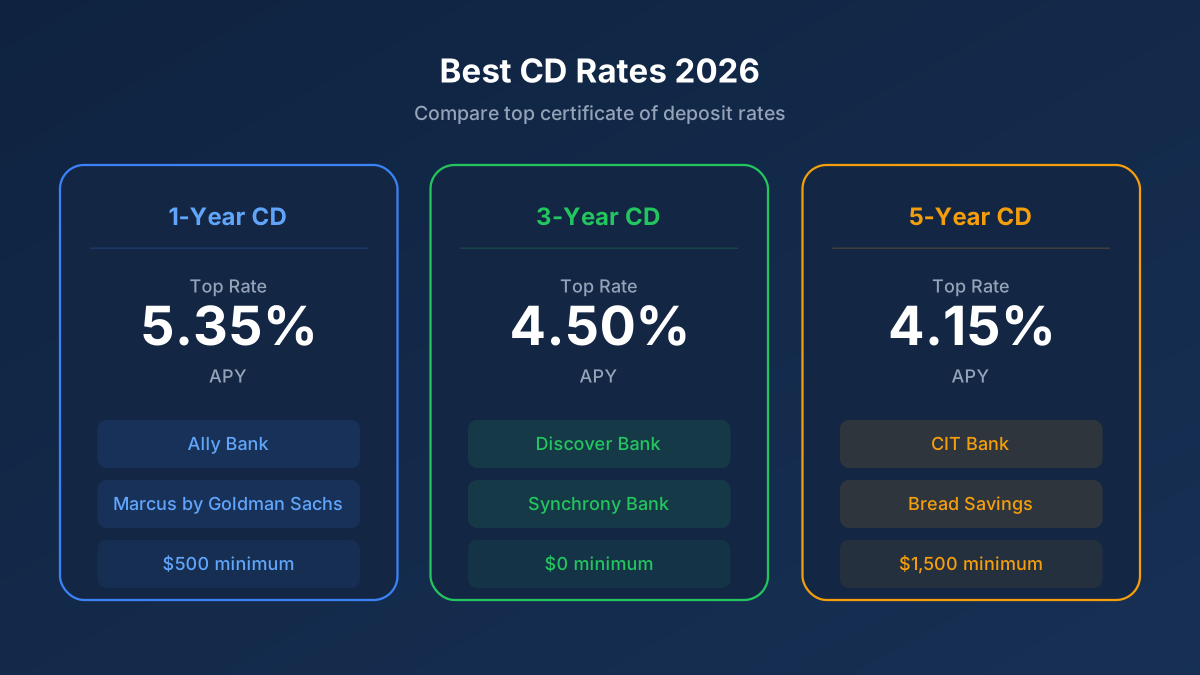
Certificate of Deposit (CD) rates remain attractive in 2026, with top-yielding accounts offering APYs between 4.25% and 5.00%. We monitor rates from over 30 banks and credit unions daily to bring you the most current and competitive CD rates across all terms. Whether you are looking for a short-term 3-month CD or a longer 5-year commitment, this guide covers the best options available today.
Key Takeaways
- Compare the best CD rates of 2026.
- We track rates from 30+ banks and credit unions to find the highest APYs across 3-month to 5-year terms.
- Current Best CD Rates (June 2026)
Current Best CD Rates (June 2026)
How We Choose
Our recommendations are based on the following criteria:
- Data-driven analysis: We compare rates, fees, and features from official sources including lender websites, SEC filings, and FDIC data.
- Regular updates: Rates and terms are verified at least monthly. Last updated June 2026.
- Objective criteria: Every product is scored on the same metrics regardless of affiliate relationships.
- Editorial independence: Affiliate partnerships do not influence our rankings. See our editorial policy.
Here are the top CD rates available nationwide as of June 2026. These rates are updated weekly based on our monitoring of over 30 financial institutions. Rates sourced from the FDIC National Rate Database and individual bank websites, verified June 2026.
| Term | Top APY | Bank | Minimum Deposit | Early Penalty |
|---|---|---|---|---|
| 3-Month | 4.50% | CIT Bank | $1,000 | 90 days interest |
| 6-Month | 4.75% | CIT Bank | $1,000 | 90 days interest |
| 9-Month | 4.60% | Marcus by Goldman Sachs | $500 | 90 days interest |
| 1-Year | 5.00% | Bread Savings | $0 | 180 days interest |
| 18-Month | 4.80% | Discover Bank | $2,500 | 180 days interest |
| 2-Year | 4.50% | Synchrony Bank | $2,000 | 180 days interest |
| 3-Year | 4.35% | Ally Bank | $0 | 150 days interest |
| 5-Year | 4.25% | Synchrony Bank | $2,000 | 180 days interest |
How We Rate CD Accounts
Our ratings consider five factors: APY competitiveness, minimum deposit requirements, early withdrawal penalties, customer satisfaction, and account features. We prioritize accounts that offer competitive rates without requiring high minimum deposits. All featured accounts are FDIC or NCUA insured up to $250,000 per depositor per institution.
Top Banks for CDs in 2026
1. Bread Savings
Bread Savings (member FDIC, formerly Comenity Direct) offers the highest 1-year CD rate at 5.00% APY with a $0 minimum deposit and no monthly fees. Their online platform makes account opening simple, and funds are available at maturity without automatic renewal — the maturity proceeds are deposited back to your linked external account. Customer service is available via phone and secure messaging. Bread Financial is a publicly-traded company (NYSE: BFH) with over $5 billion in total deposits as of Q1 2026.
Best for: Savers looking for the highest 1-year return with zero minimum investment.
2. CIT Bank
CIT Bank (a division of First Citizens Bank, member FDIC) offers a 6-month CD at 4.75% APY and a 3-month CD at 4.50% APY. Their No-Penalty CD (11-month term at 4.25% APY) allows penalty-free withdrawals after just 6 days — ideal for emergency funds. Minimum deposit: $1,000. First Citizens Bank (NASDAQ: FCNCA) has over $200 billion in total assets, making CIT Bank one of the most financially stable online banking options.
Best for: Short-term savers and those wanting no-penalty withdrawal options.
3. Discover Bank
Discover Bank (member FDIC) offers an 18-month CD at 4.80% APY and a 1-year CD at 4.60% APY. All Discover CDs include a 10-day grace period after maturity with no automatic renewal. Discover is known for excellent customer service (ranked #1 in J.D. Power 2025-2026 U.S. Banking Satisfaction Study), a highly rated mobile app (4.8/5 on App Store), and 24/7 US-based support. No minimum deposit is required.
Best for: Savers who value customer service and a seamless digital experience.
Our Recommendation
We may earn a commission if you make a purchase, at no extra cost to you.
4. Ally Bank
Ally Bank (member FDIC) offers a 3-year CD at 4.35% APY with a $0 minimum deposit. Their Raise Your Rate CD allows one rate increase during the term if Ally raises rates. Standard CDs include a 10-day best rate guarantee if Ally's rates increase within 10 days of opening. Early withdrawal penalty: 150 days of interest for terms 2-3 years. Ally is consistently ranked among the top online banks for customer satisfaction with a 4.7/5 Trustpilot rating.
Best for: Mid-term savers who want rate protection and flexible withdrawal options.
5. Marcus by Goldman Sachs
Marcus by Goldman Sachs (member FDIC) offers a 9-month CD at 4.60% APY with a $500 minimum deposit. Marcus CDs automatically renew at maturity with a 10-day grace period to withdraw or adjust. Unique feature: you can add funds to certain CDs within the first 30 days of opening. Goldman Sachs (NYSE: GS) is one of the world's largest investment banks with over $1.6 trillion in assets under management. Their online platform is clean and easy to use with no fees of any kind.
Best for: Savers who want a reputable name with flexible funding options.
CD Ladder Strategy
A CD ladder is a strategy that maximizes returns while maintaining regular access to your money. Here is how to build one:
How it works: Divide your savings into 5 equal parts and invest each in CDs with different terms — 1-year, 2-year, 3-year, 4-year, and 5-year. When the 1-year CD matures, reinvest it into a new 5-year CD. Each year one CD matures, giving you annual access to funds while maintaining the average return of longer-term rates.
Example with $25,000: Invest $5,000 in each of five CDs. At current rates, a 5-rung ladder would earn an average APY of approximately 4.50% while keeping one rung accessible each year. Use our CD calculator to model different ladder strategies and compare returns across terms.
Comparing CD Types
| Type | Best For | Typical APY | Early Withdrawal |
|---|---|---|---|
| Traditional CD | Fixed savings goal | 4.25%-5.00% | Penalty applies |
| No-Penalty CD | Emergency fund | 4.00%-4.50% | No penalty after 7-10 days |
| Bump-Up CD | Rising rate environment | 4.00%-4.40% | Penalty applies |
| Step-Up CD | Predictable rate increases | 3.50%-4.25% | Penalty applies |
| Jumbo CD ($100k+) | Large savers | 4.50%-5.25% | Penalty applies |
| IRA CD | Retirement savings | 4.25%-4.75% | Penalty + tax implications |
CD vs. High-Yield Savings Account
Both CDs and high-yield savings accounts (HYSAs) are safe savings tools, but they serve different purposes:
CDs lock in a fixed rate for a specific term. If rates drop, you benefit from the higher locked rate. If rates rise, you miss out. Best for money you do not need immediate access to.
HYSAs offer variable rates that change with the market. You can withdraw anytime without penalty. Best for emergency funds and short-term savings.
As of June 2026, top HYSAs offer 4.25-4.50% APY while top 1-year CDs offer 4.75-5.00% APY. The slight premium for CDs reflects the commitment to locking your funds. For more on HYSAs, see our high-yield savings guide.
CD Tax Implications
CD interest is taxed as ordinary income at your marginal federal tax rate, plus applicable state and local taxes. A 5.00% APY CD effectively earns less after taxes depending on your bracket. Consider holding CDs in tax-advantaged accounts like IRAs if possible.
For high earners in the 35% federal bracket, a 5.00% APY CD yields just 3.25% after federal taxes. Factor this into your comparison when evaluating CD returns against other investments.
Frequently Asked Questions
Are CDs FDIC insured?
Yes, CDs from FDIC-member banks are insured up to $250,000 per depositor per institution. Credit union CDs are similarly insured by the NCUA. This makes CDs one of the safest investment options available.
What happens when a CD matures?
Most banks automatically renew CDs at the current rate for the same term unless you instruct otherwise. You typically have a grace period of 7-14 days after maturity to withdraw or change terms without penalty. Set a calendar reminder to review your options before each CD matures.
Can I add money to an existing CD?
Most traditional CDs do not allow additional deposits after opening. However, some banks like Marcus by Goldman Sachs allow adding funds within the first 30 days. If you want the ability to add funds regularly, consider a CD IRA or a savings account instead.
How are CD early withdrawal penalties calculated?
Penalties typically equal a certain number of months of interest. For short-term CDs (under 1 year), the penalty is usually 1-3 months of interest. For longer terms, penalties range from 6 to 12 months of interest. Some banks deduct the penalty from your principal if insufficient interest has been earned, potentially losing some of your deposit.
Strategy tip: With CD rates near 5.00% for 1-year terms, now is an excellent time to lock in yields before potential rate cuts later in 2026. Consider a barbell strategy put half in short-term CDs (6-12 months) for liquidity and half in longer terms (2-5 years) to lock in current rates.
CDs remain a cornerstone of conservative savings strategies in 2026. By shopping for the best rates and structuring a ladder, you can maximize returns while maintaining safety and liquidity. For more savings strategies, read our guides on high-yield savings accounts, building an emergency fund, and how to save money.