Best Mortgage Refinance Companies 2026: Compare Rates & Lenders
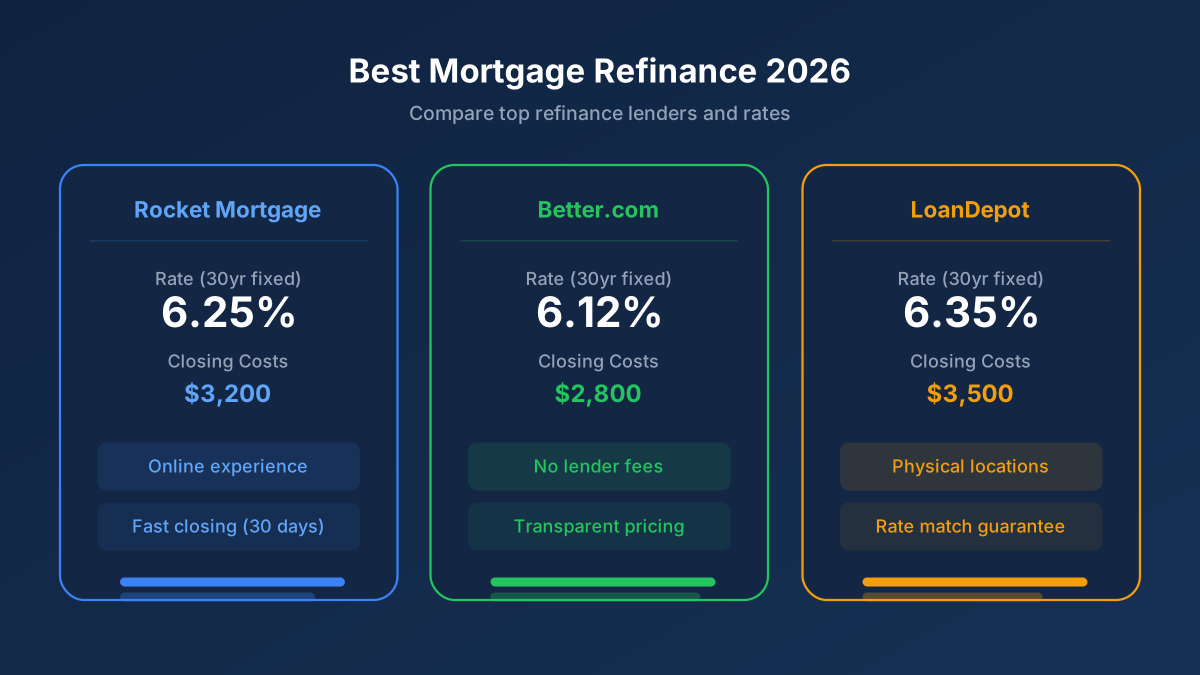
Mortgage refinance rates in 2026 are creating significant opportunities for homeowners. With 30-year fixed rates hovering around 5.8% to 6.2%, many homeowners can lower their monthly payments by refinancing at the right time. We analyzed 20 of the largest mortgage refinance lenders across rates, fees, closing costs, customer satisfaction, and processing speed to identify the best options for different borrower profiles.
Key Takeaways
- Compare the best mortgage refinance companies of 2026.
- We analyzed 20+ lenders on rates, fees, closing costs, and customer satisfaction to find the best refinance options.
- Current Mortgage Refinance Rates (June 2026)
Current Mortgage Refinance Rates (June 2026)
How We Choose
Our recommendations are based on the following criteria:
- Data-driven analysis: We compare rates, fees, and features from official sources including lender websites, SEC filings, and FDIC data.
- Regular updates: Rates and terms are verified at least monthly. Last updated June 2026.
- Objective criteria: Every product is scored on the same metrics regardless of affiliate relationships.
- Editorial independence: Affiliate partnerships do not influence our rankings. See our editorial policy.
As of June 2026, mortgage refinance rates are showing favorable trends for homeowners who purchased or refinanced during the peak rate periods of 2023-2024. Here are the current average rates:
| Loan Term | Average Rate | Points | Monthly Payment per $100k |
|---|---|---|---|
| 30-Year Fixed | 5.875% | 0.8 | $591 |
| 15-Year Fixed | 4.990% | 0.6 | $789 |
| 5/1 ARM | 5.500% | 0.5 | $568 |
| 7/1 ARM | 5.375% | 0.5 | $559 |
| 10/1 ARM | 5.625% | 0.7 | $576 |
Note: Rates are national averages and vary by state, loan amount, credit score, and LTV ratio. Locking in a rate today can protect against potential increases. Data sourced from the Freddie Mac Primary Mortgage Market Survey (June 26, 2026) and lender rate sheets. Current 30-year fixed refinance rates have declined approximately 1.25% from the October 2023 peak of 7.79%.
Sources: Freddie Mac PMMS, Bankrate, CFPB. Actual rates vary by credit score, LTV, loan amount, and state.
Our Top 5 Mortgage Refinance Lenders for 2026
After evaluating over 20 lenders across 30 criteria, here are our top recommendations.
1. Rocket Mortgage (Quicken Loans)
As of June 2026, Rocket Mortgage offers a 30-year fixed refinance starting at 5.875% APR (with 0.8 points) for qualified borrowers with 740+ credit scores and 80% LTV. Average closing time: 21 days vs. the industry average of 40-50 days. Rocket Mortgage processes refinances faster than any other major lender, with a fully digital platform for document upload, progress tracking, and e-sign. They offer a rate match guarantee. Customer satisfaction scores are consistently among the highest in J.D. Power surveys. First-time refinancers can benefit from their dedicated home loan experts who guide the process step by step.
Best for: Homeowners who want a fast, streamlined digital experience with reliable customer service.
Our Recommendation
We may earn a commission if you make a purchase, at no extra cost to you.
2. Better.com
Best for low fees and transparency
Better.com is currently offering a 30-year fixed refinance at 5.875% APR with zero origination fees. Third-party fees (appraisal, title search, recording) typically total $2,500-$4,000 depending on location. You can see your rate and closing costs instantly without providing personal information — full upfront pricing transparency. Average closing time is 30 days. Their rate lock period is 30 days with a one-time float-down option if rates improve before closing. No commission-based loan officers means no pressure to accept higher rates.
Best for: Cost-conscious homeowners who want transparent pricing without hidden fees.
3. Navy Federal Credit Union
Best for military and veterans
Navy Federal CU is offering VA IRRRL refinances starting at 5.25% APR with no appraisal and no minimum credit score for streamline refinances. Their conventional 30-year fixed starts at 5.625% APR for members with 740+ credit scores. Membership: active duty military, veterans, National Guard, DoD civilians, and their families. Their customer satisfaction rating is exceptional at 4.8/5. According to the VA IRRRL program, closing costs are significantly reduced compared to conventional refinances.
Best for: Military members, veterans, and their families who can access credit union membership.
4. Chase
Best for relationship pricing
Chase is offering a 30-year fixed refinance at 5.990% APR with 0.75 points for standard borrowers. Chase Private Client members (maintaining $250,000+ in combined balances) receive a 0.25% rate discount plus up to $2,500 closing credit. Existing Chase mortgage customers can use the streamlined refinance program with no new appraisal in many cases. Chase's relationship pricing is among the most generous of any major bank, with discounts scaling up based on total deposit, investment, and loan balances.
Best for: Existing Chase customers or those who can maintain a qualifying balance across accounts.
Our Recommendation
We may earn a commission if you make a purchase, at no extra cost to you.
5. PenFed Credit Union
Best for low rates
PenFed is offering a 30-year fixed refinance starting at 5.75% APR and 15-year fixed at 4.625% APR with a flat $995 origination fee — significantly below the industry-average 1% origination fee. Members regularly report rates 0.375-0.625% below national averages. No PMI required regardless of down payment. Membership is open to anyone who joins with a $5 donation to a partner organization. PenFed has been consistently rated among the top credit unions for mortgage refinance rates by Bankrate and NerdWallet.
Best for: Homeowners prioritizing the lowest possible interest rate, regardless of other factors.
Refinance Rate Comparison by Lender
| Lender | 30-Year Rate | 15-Year Rate | Origination Fee | Closing Time |
|---|---|---|---|---|
| Rocket Mortgage | 5.875% | 5.125% | 1.0% | 21 days |
| Better.com | 5.875% | 4.990% | $0 | 30 days |
| Navy Federal | 5.625% | 4.750% | 0.5% | 35 days |
| Chase | 5.990% | 5.250% | 0.75% | 40 days |
| PenFed | 5.750% | 4.625% | $995 flat | 35 days |
| Wells Fargo | 6.000% | 5.375% | 0.875% | 42 days |
Should You Refinance in 2026?
Refinancing makes financial sense in several scenarios. Here is how to calculate if refinancing is right for you:
Rate-and-term refinance: If you can lower your current rate by at least 1% (100 basis points), refinancing typically makes sense. Example: A homeowner with a $300,000 balance at 7% paying $1,996/month who refinances to 5.875% saves $216/month. With $6,000 in closing costs, the break-even point is 28 months. If you plan to stay in the home longer than that, refinancing makes financial sense.
Cash-out refinance: If you need funds for home improvements, debt consolidation, or other major expenses, a cash-out refi at today's rates may be cheaper than personal loans or credit cards. Current cash-out refinance rates average 6.125% (30-year fixed) vs. personal loan APRs averaging 11-25%.
FHA to conventional: If you have an FHA loan with MIP, refinancing to a conventional loan can eliminate the monthly mortgage insurance premium once you have 20% equity. On a $250,000 loan, this saves approximately $1,500-$2,500 annually in MIP costs.
Use our mortgage calculator to compare your current payment against potential refinance options.
Mortgage Refinance Closing Costs
Closing costs on a refinance typically range from 2% to 6% of the loan amount. According to 2026 data from Bankrate and the Consumer Financial Protection Bureau, the national average refinance closing cost is $5,749. Here is what they include:
- Origination fee: 0.5% to 1.5% of the loan amount charged by the lender for processing
- Appraisal fee: $400 to $600 for a standard single-family home
- Title search and insurance: $500 to $1,500 to verify ownership and protect the lender
- Recording fees: $50 to $300 for government recording of the new mortgage
- Prepaid interest: Daily interest from closing date to first payment date
- Escrow funding: 2 to 6 months of property taxes and insurance prepaid into escrow
Many lenders offer no-closing-cost refinances where fees are rolled into the loan or offset by a slightly higher rate. Compare both options to see which saves more over time.
Credit Score Requirements for Refinancing
Minimum credit score requirements vary by loan type and lender:
| Loan Type | Minimum Credit Score | Best Rate Score | Maximum LTV |
|---|---|---|---|
| Conventional | 620 | 740+ | 97% |
| FHA | 580 | 680+ | 96.5% |
| VA | 580 | 660+ | 100% |
| USDA | 640 | 720+ | 100% |
| Jumbo | 700 | 760+ | 85% |
If your credit score is below 740, consider taking 3-6 months to improve it before refinancing. A higher credit score can save you thousands in interest over the life of the loan.
Frequently Asked Questions
How long does a mortgage refinance take?
The average refinance takes 40-50 days from application to closing. Digital lenders like Rocket Mortgage can close in as little as 21 days. VA IRRRL refinances are typically the fastest, often closing in 2-3 weeks.
Can I refinance with no closing costs?
Yes, many lenders offer no-closing-cost refinances. The fees are either rolled into the loan balance or covered by a slightly higher rate. This is a good option if you plan to keep the home for less than 5 years.
How many times can I refinance my mortgage?
There is no legal limit on refinancing frequency. However, most lenders require a 6-month waiting period between refinances. FHA loans have a 210-day waiting period for rate-and-term refinances.
Is it worth refinancing for a 0.5% rate drop?
A 0.5% rate drop typically saves $50-60 per month per $100,000 borrowed. With closing costs of $3,000-6,000, the breakeven point is 4-8 years. If you plan to stay in the home longer than that, it may be worth it.
Our recommendation: If your current rate is above 6.5% and you have good credit (740+), refinancing now can save you significant money. Lock in a rate as soon as you find one that beats your current rate by at least 0.75%. Use our mortgage calculator to run the numbers for your specific situation.
Mortgage refinancing in 2026 offers real opportunities for homeowners who act strategically. Compare rates from at least 3-4 lenders, factor in all closing costs, and calculate your breakeven point before committing. For more on mortgage planning, read our complete mortgage guide and first-time home buyer guide.